
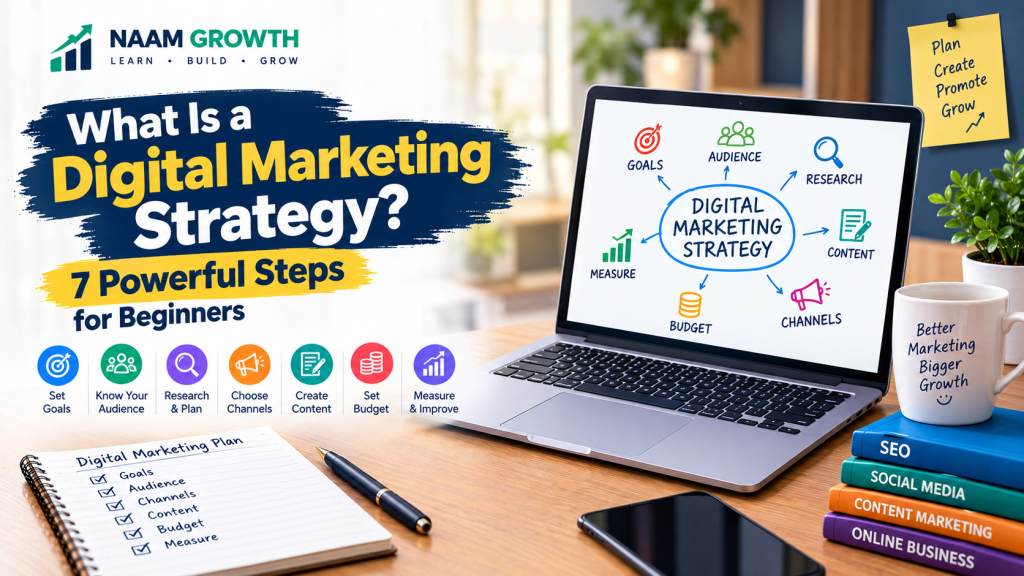
A strong online presence does not happen by accident. Businesses need a clear plan to understand their audience, choose the right digital channels, create useful content, and measure what is working.
If you are wondering what is a digital marketing strategy, think of it as a practical roadmap that connects your business goals with your audience, marketing channels, content, campaigns, and measurable results.
In this beginner-friendly guide, we will explore seven practical steps for building a digital marketing strategy and explain how each step can support long-term online growth.
Table of Contents
- What Is a Digital Marketing Strategy?
- Why Is a Digital Marketing Strategy Important?
- 7 Powerful Steps to Build a Digital Marketing Strategy
- 1. Define Your Business Goals
- 2. Understand Your Target Audience
- 3. Research Your Market and Competitors
- 4. Choose the Right Digital Marketing Channels
- 5. Create Useful and Relevant Content
- 6. Set a Realistic Budget
- 7. Measure, Learn, and Improve
- Common Digital Marketing Strategy Mistakes
- Useful Tools for Digital Marketing
- How SEO Fits Into Your Strategy
- Final Thoughts
What Is a Digital Marketing Strategy?
A digital marketing strategy is a structured plan for using digital channels and online activities to achieve specific business goals. It helps a business decide who to reach, what message to communicate, where to reach people, and how to measure progress.
A strategy can include several areas such as search engine optimization (SEO), social media marketing, content marketing, email marketing, paid advertising, and e-commerce.
The exact combination depends on the business, audience, resources, industry, and objectives. A small local business may need a different approach from an online store or a global company.
If you are new to digital marketing, start with our beginner’s guide: What Is Digital Marketing? 6 Key Areas Every Beginner Should Know .
Why Is a Digital Marketing Strategy Important?
Without a clear plan, businesses can spend time and money on digital activities without knowing whether those activities are helping them reach their goals. A strategy provides direction and makes it easier to prioritize marketing work.
- Provides clear direction: A strategy connects daily marketing activities with broader business goals.
- Helps understand the audience: Research makes it easier to create messages and content that address real customer needs.
- Improves resource allocation: A clear plan helps businesses decide where to invest their time, budget, and effort.
- Creates consistency: A strategy can keep messaging, content, and campaigns aligned across different digital channels.
- Makes measurement easier: Defined goals and metrics provide a basis for reviewing performance and making improvements.
7 Powerful Steps to Build a Digital Marketing Strategy
Building a useful strategy does not require complicated software or a huge marketing budget. The process starts with understanding the business and its customers, then creating a practical plan that can be measured and improved.
1. Define Your Business Goals
Every effective marketing plan should begin with a clear understanding of what the business wants to achieve.
Your goal might be to increase website traffic, generate leads, improve brand awareness, increase online sales, grow an email list, or attract more customers.
Try to make your goals specific and measurable. Instead of saying “I want more customers,” define what improvement you want to see and within what period.
Clear goals make it easier to choose the right channels and determine which metrics should be monitored.
2. Understand Your Target Audience
Knowing your audience is one of the most important parts of a successful digital marketing strategy.
Think about who your potential customers are, what problems they have, what they want to achieve, and what questions they ask before making a decision.
You can research your audience through customer conversations, surveys, website analytics, social media insights, reviews, search behavior, and competitor research.
The better you understand your audience, the easier it becomes to create useful content and communicate a relevant message.
3. Research Your Market and Competitors
Competitor research can help you understand the digital environment in which your business operates.
Look at the types of content competitors publish, the platforms they use, the products or services they promote, and the questions they appear to answer for their audiences.
The goal is not to copy competitors. Instead, use research to identify opportunities, gaps, customer needs, and areas where your business can provide additional value.
4. Choose the Right Digital Marketing Channels
Not every business needs to use every digital marketing channel. Choosing the right channels depends on where your audience spends time and how those channels support your goals.
Search Engine Optimization
SEO can help people discover your website through relevant organic searches. It is particularly useful when potential customers actively search for information, products, or services.
If you want to understand SEO from the beginning, read our guide: What Is SEO? A Beginner’s Guide to Search Engine Optimization .
Social Media Marketing
Social media can help businesses build awareness, communicate with audiences, share content, and create ongoing engagement.
Content Marketing
Content marketing focuses on creating and distributing useful information that can help attract, educate, and engage a target audience.
Paid Advertising
Paid advertising can help businesses reach specific audiences through advertising platforms. Campaigns can be designed around goals such as traffic, leads, sales, or awareness.
Email Marketing
Email marketing allows businesses to communicate directly with people who have chosen to receive their messages. It can be useful for nurturing relationships, sharing updates, and promoting relevant offers.
5. Create Useful and Relevant Content
Content is an important part of many digital marketing strategies. However, creating more content does not automatically mean creating better content.
Focus on content that answers real questions, solves problems, explains products or services, or provides useful information to your audience.
Depending on your business, content may include:
- Blog articles
- Social media posts
- Short-form videos
- Long-form videos
- Product guides
- Case studies
- Email newsletters
- Infographics
A useful content plan should also consider the customer’s journey. Someone discovering your brand for the first time may need educational content, while an existing customer may need product information or support.
For e-commerce businesses, useful product content also matters. A well-optimized product page can support both search visibility and the customer experience. Learn more in our guide to Product Page Optimization.
6. Set a Realistic Budget
A digital marketing strategy should consider the resources available to the business. Your budget may include advertising, software, content creation, design, website development, and other marketing activities.
You do not necessarily need a large budget to start. A small business can begin with a focused plan, test different approaches, measure the results, and gradually increase investment when the data supports it.
The key is to understand where your money is going and what you are trying to achieve with that investment.
7. Measure, Learn, and Improve
Digital marketing becomes more useful when you measure performance and use the information to make better decisions.
Depending on your goals, useful metrics may include:
- Website traffic
- Organic search impressions
- Search clicks
- Engagement
- Leads
- Conversion rate
- Online sales
- Advertising cost and return
For website and search performance, Google’s official Google Search Console can provide useful search-related information.
You can also learn more about Google’s approach to search optimization in the official SEO Starter Guide .
For website analytics, businesses can use Google Analytics to understand how visitors interact with their websites.
Review your data regularly, identify what is working, and improve the parts that are not performing as expected. This cycle of testing and learning is an important part of sustainable digital growth.
Common Digital Marketing Strategy Mistakes
Beginners often make avoidable mistakes when creating their first digital marketing plan. Being aware of these issues can help you build a more practical strategy.
- Trying to use every platform: Being active everywhere can spread your resources too thin.
- Ignoring the target audience: Marketing becomes less effective when content is created without understanding the people it is intended to reach.
- Focusing only on followers: Follower counts do not tell the complete story of marketing performance.
- Creating content without a purpose: Every piece of content should have a clear reason for existing.
- Ignoring measurement: Without tracking relevant metrics, it is difficult to understand what needs improvement.
- Expecting instant results: Different marketing channels can require different amounts of time and experimentation.
- Changing strategy too quickly: Constantly changing direction without enough information can make performance difficult to evaluate.
Useful Tools for Digital Marketing
Digital marketers have access to many tools for research, analytics, content, SEO, advertising, and project management. Beginners should start with tools that match their current goals rather than trying to use everything at once.
- Google Search Console: Useful for monitoring website search performance and indexing information.
- Google Analytics: Useful for understanding website traffic and visitor behavior.
- Google Trends: Useful for exploring changes in search interest and comparing topics.
- Google Keyword Planner: Useful for researching search terms and advertising-related keyword ideas.
- Rank Math: A WordPress SEO plugin that provides tools for content optimization and SEO management.
How SEO Fits Into Your Digital Marketing Strategy
SEO is one part of a broader digital marketing strategy. It can help businesses reach people who are actively searching for relevant information, products, or services.
A strong approach can connect SEO with content marketing, social media, e-commerce, email marketing, and other channels.
For example, a business might publish a useful SEO-focused article, share that article through social media, collect interested visitors through an email list, and guide relevant users toward a product or service.
This shows why digital marketing works best when different activities support a common business goal rather than operating as completely separate tasks.
For businesses working on SEO at the page level, understanding On-Page SEO and Technical SEO can also help create a stronger foundation for search visibility.
Final Thoughts
Understanding what is a digital marketing strategy is only the beginning. The real value comes from turning that understanding into a clear, practical, and measurable plan.
Start by defining your goals, understanding your audience, researching your market, selecting suitable channels, creating useful content, setting a realistic budget, and measuring your performance.
You do not need to build a complicated system on day one. Start with a focused plan, learn from your data, improve your approach, and gradually expand as your business grows.
Digital marketing is an ongoing process of learning, testing, and improving. A thoughtful strategy can give your marketing activities clearer direction and help you make better decisions over time.
Ready to Build Your Digital Growth Strategy?
Explore more practical guides on digital marketing, SEO, e-commerce, and growth strategy from NAAM Growth.
Explore More ArticlesNext: Continue with our practical guide on Keyword Research for Beginners.