
Table of Contents
- What Is On-Page SEO?
- Why Does On-Page SEO Matter?
- 1. Optimize Your Page Title
- 2. Create a Clear Heading Structure
- 3. Optimize Your Content
- 4. Use Relevant Keywords Naturally
- 5. Optimize Images
- 6. Improve Internal Linking
- 7. Create Helpful and User-Focused Content
- Common On-Page SEO Mistakes
- Final Thoughts
If you want your website to perform better in search engines, creating useful content is only part of the process. You also need to make sure that each page is properly organized and optimized.
This is where on-page SEO comes in. On-page SEO focuses on improving elements of a webpage so that search engines can better understand the content and users can find the information they need more easily.
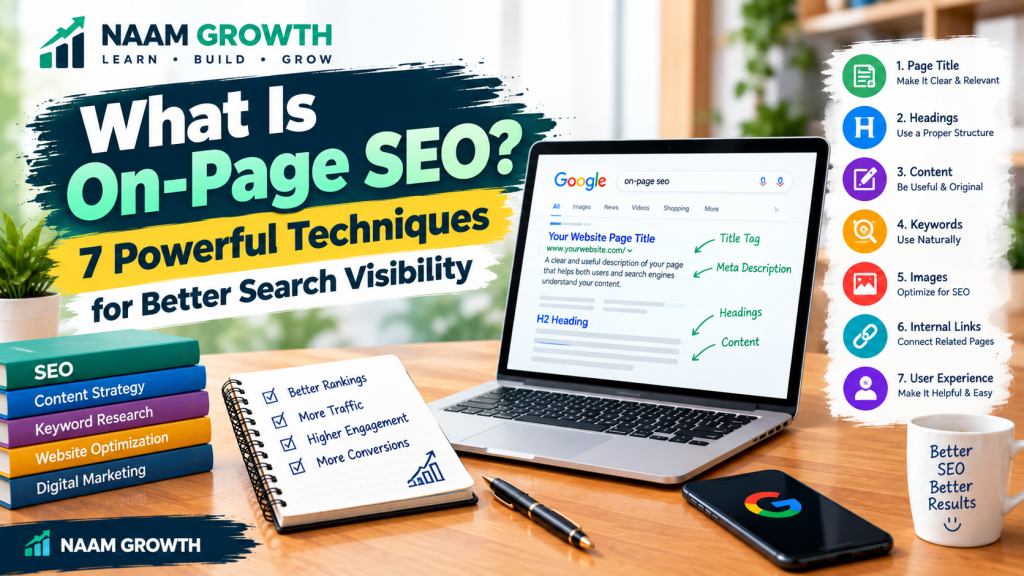
In this beginner-friendly guide, we will explore what on-page SEO is and discuss 7 practical techniques you can use to optimize your website pages.
What Is On-Page SEO?
On-page SEO refers to optimizing the content and elements of individual webpages to help search engines understand the page and provide a better experience for visitors.
It can include elements such as page titles, headings, content, keywords, images, internal links, URLs, and other page-level information.
The goal is not simply to add as many keywords as possible. Instead, the goal is to create a clear, useful, relevant, and well-structured page that satisfies the visitor’s search intent.
On-page SEO is one part of the broader SEO process. Understanding how different SEO elements work together can help you build a more complete approach to optimizing your website.
For more general SEO guidance, you can also explore Google’s Google Search Central SEO resources.
Why Does On-Page SEO Matter?
Search engines need to understand what a webpage is about before they can decide how it may be relevant to a search query. A well-structured page can make that understanding easier.
On-page SEO can also improve the user experience by making your content easier to read, navigate, and understand.
For example, a properly optimized article may have a descriptive title, clear headings, useful information, relevant images, and internal links that help visitors discover related content.
A strong on-page SEO process also works together with technical SEO, keyword research, and a broader digital marketing strategy.
Let’s look at seven practical techniques you can use.
1. Optimize Your Page Title
The page title is one of the first things users may see when your page appears in search results. It also helps communicate what the page is about.
A good title should be:
- Clear and descriptive
- Relevant to the page content
- Useful to the searcher
- Naturally written
- Different from the titles of other pages on your website
For example, instead of using a generic title such as “SEO Tips”, you could use something more descriptive such as “7 On-Page SEO Techniques for Beginners”.
Avoid creating titles simply by repeating keywords. Your title should accurately describe what visitors will find on the page.
2. Create a Clear Heading Structure
Headings help organize your content into logical sections. They make long articles easier for visitors to scan and understand.
A simple structure might look like this:
- H1: Main page or article title
- H2: Main sections
- H3: Supporting sections
For example, an article about SEO could have an H2 heading called “Keyword Research” and H3 headings under it covering different keyword research methods.
Use headings to describe the actual content of each section rather than inserting keywords just for SEO purposes.
3. Optimize Your Content
High-quality content is an important part of on-page SEO. Your content should provide useful information that addresses the reason someone visited your page.
When creating content, consider:
- What question is the visitor trying to answer?
- What information do they actually need?
- Can the topic be explained more clearly?
- Are the examples useful and relevant?
- Is the content easy to read?
Avoid adding unnecessary paragraphs simply to make an article longer. A useful, focused article is generally more valuable than content filled with repetition.
If you are planning content around a specific topic, our guide on Keyword Research for Beginners explains how to identify relevant search terms and understand search intent before creating content.
4. Use Relevant Keywords Naturally
Keywords help describe the topic of your content, but they should be used naturally.
For example, if your target topic is on-page SEO, you might naturally use related terms such as:
- on-page SEO techniques
- SEO optimization
- page optimization
- SEO content
- website optimization
However, you don’t need to force these terms into every paragraph. Repeating the same keyword excessively can make content difficult to read and may create a poor user experience.
The focus should be on explaining the topic naturally and completely rather than trying to reach an arbitrary keyword density.
5. Optimize Images
Images can make your content more engaging, but they should also be properly prepared for the page.
Some useful image optimization practices include:
- Use relevant images
- Choose descriptive file names
- Add meaningful alt text where appropriate
- Use suitable image dimensions
- Avoid unnecessarily large image files
For example, instead of a file name such as IMG1234.jpg, a descriptive file name such as on-page-seo-techniques.jpg can provide more context.
Alt text should describe the image when it is useful for accessibility and when search engines need additional context about the image.
6. Improve Internal Linking
Internal links connect one page of your website to another page on the same website. They can help visitors discover related content and navigate your site.
They can also help search engines discover relationships between different pages on your website.
For example, if you are learning about on-page SEO, you may first want to understand keyword research.
You can also learn more about Google Search Console to understand how website owners can monitor search performance and indexing.
For e-commerce websites, internal links can also connect informational SEO content with useful resources such as product page optimization.
Use descriptive and natural anchor text instead of repeatedly using generic phrases such as “click here.”
7. Create Helpful and User-Focused Content
Perhaps the most important part of on-page SEO is creating content that genuinely helps your audience.
Before publishing a page, ask yourself:
- Does this page answer the visitor’s question?
- Is the information clear and easy to understand?
- Does the content provide useful examples?
- Is the page organized logically?
- Would a visitor find the content useful?
SEO should support the user experience rather than replace it. If visitors cannot understand your content, adding more keywords will not solve the underlying problem.
A clear content plan should also be connected to your overall digital marketing strategy, especially when SEO is one of several channels you use to reach your audience.
Common On-Page SEO Mistakes
Beginners often make several common mistakes when optimizing webpages.
- Repeating keywords unnaturally
- Writing titles that do not accurately describe the page
- Using unclear or poorly organized headings
- Publishing thin or repetitive content
- Ignoring internal linking
- Using irrelevant images
- Forgetting useful alt text where appropriate
- Optimizing only for search engines instead of users
A good SEO strategy focuses on creating useful pages first and optimizing them thoughtfully.
Final Thoughts
On-page SEO is one of the fundamental parts of search engine optimization. It involves improving the content, structure, and page-level elements of your website so that both users and search engines can better understand your pages.
The seven techniques discussed in this guide can give beginners a practical starting point:
- Optimize your page title
- Create a clear heading structure
- Optimize your content
- Use relevant keywords naturally
- Optimize images
- Improve internal linking
- Create helpful and user-focused content
Remember that SEO is not about making a webpage look optimized. It is about making the page genuinely useful, understandable, and accessible to the people who need it.
If you are new to SEO, you can continue your learning with our Keyword Research for Beginners guide, our guide to Google Search Console, and our beginner-friendly guide to Technical SEO.
Ready to Improve Your Website?
Start with one page at a time. Research your topic, understand your audience, create helpful content, and optimize each important element naturally.
Keep learning. Keep testing. Keep growing with NAAM Growth.